2011-08-10 "South Pacific islanders visit S.F. Bay, by canoe; Contingent from South Pacific isles arrives in replicas of ancient boats" by Carl Nolte from "San Francisco Chronicle"
[http://articles.sfgate.com/2011-08-10/bay-area/29870736_1_canoes-sailors-flotilla]
SAN FRANCISCO -- Half a dozen canoes from islands of the South Pacific landed on the beach at Aquatic Park today as part of a weeklong visit to San Francisco - the first stop on the coast of what these Polynesian sailors call "Turtle Island."
Turtle Island is their term for the mainland of the United States, and the canoes are on a 15,000-mile ocean journey from New Zealand and various Pacific Islands. The canoes are replicas of the traditional vaka moana canoes Pacific people used to explore and settle the tropical islands of the Pacific and New Zealand centuries ago.
The canoes, each about 70 feet long, carry a crew of 16 sailors from some of the smallest countries in the world, including the Cook Islands, Kiribati, Vanuatu and Tonga.
They began their trip in April from New Zealand, and sailed on the first leg to Hilo, in the Hawaiian Islands, navigating by the stars, as their ancestors did. However, the modern voyagers have canoes with hulls made of fiberglass instead of wood, and equipped with solar panels to power onboard equipment.
Though the ancient mariners steered by the stars, their descendants communicate on the Internet. The expedition has a website - www.pacificvoyagers.org - and they are on Facebook and Twitter as well.
The six-canoe flotilla came in through the Golden Gate a week ago and seemed surprised by the stiff winds and fog in the bay. The sailors held an open house over the weekend at Clipper Cove at Treasure Island and offered rides on the vakas to about 1,000 people.
Tuesday, they greeted visitors to the San Francisco Maritime National Historical Park and let landlubbers peer into their canoes and listen to sea stories - mostly about their adventures, the environment and pollution in the ocean. Their message, they said, is "we are all in one canoe."
One of the canoes - the Vaka from the Cook Islands - will sail to Pier 39 at 11 a.m. today, where the sailors will be greeted by Henry Puna, the country's prime minister.
Puna and the canoe and its crew will be the centerpiece of Cook Islands Day at the pier. The event will include drumming and dance performances.
The islands, which were formerly a dependency of New Zealand, are a territory of only 92.7 square miles spread out over 15 coral islands.
The six canoes will sail from San Francisco on Thursday, for Monterey.
The flotilla will be in Monterey on Friday until Aug. 17 and then sail for Malibu on the Los Angeles County coast. At Malibu, they will link up with representatives of the Chumash tribe of Indians, who were noted for their own seagoing canoes.
The South Seas canoe flotilla will also visit San Diego and Baja California before heading back to the Pacific Islands later this year.
Wednesday, August 10, 2011

Tuesday, August 9, 2011
2011-08-09 "Fourth Indian American Youth Congress Held in Venezuela" by Rachael Boothroyd
[http://venezuelanalysis.com/news/6413]
Coro, 9th August 2011 (Venezuelanalysis.com) – Over 400 delegates from 18 different countries attended the fourth Indian American Youth Congress which concluded Tuesday in Caracas.
As part of the celebrations for international indigenous day, indigenous groups from all over the Latin American region met in the Venezuelan capital to discuss issues surrounding food security, human rights, the safeguarding of indigenous culture and how to strengthen the current political processes taking place in Latin America.
Dalia Yánez, Coordinator of the Indigenous Commission of the Latin American Parliament, highlighted the importance of the Congress since indigenous peoples were still subject to racism on the continent, despite political progress.
“The struggle and resistance continues...there have been some political advances, but there is still discrimination, we still have yet to reach our goal” said Yanez.
Many representatives emphasised that the current political processes taking place in Latin America had opened up the political arena to the region’s indigenous groups like never before, and that these groups now had a say in national political debate for the first time in the continent’s history.
“The struggle at a global level that the states recognise, which the Venezuelan state has recognised, are the rights of the indigenous populations, the right to land and its preservation in the face of the foreign companies that invade the natural spaces of the world” said Estaben Perez, Representative of the Venezuelan Indigenous American Parliament.
“In Venezuela there is a process that is conscious of this...in these 12 years there have been advances within the sphere of public life” continued Perez.
Similarly, Jorge Alvarado, Embassador of the Plurinational State of Bolivia in Venezuela, spoke positively about the government of Bolivia’s indigenous president Evo Morales, but also highlighted that the same oligarchy that traditionally subjugated Bolivia’s indigenous population “continues to make the job difficult”.
In the closing ceremony the delegates declared themselves to be “against capitalism and for socialism” and vowed to construct an alternative development model. The statement, read by Bolivian delegate Maya Yapú, also guaranteed social inclusion, as well as respect for economic, environmental, social and political rights. Declaring the movements’ solidarity with the Chilean Mapuches, Venezuelan president Hugo Chávez and regional initiatives such as the ALBA (Bolivarian Alliance for the Peoples of Our America), the statement also denounced U.S. and European imperialist aggression against Libya and Afghanistan.
In more concrete initiatives, Yapú also announced the creation of the Bolivarian Indigenous Youth movement, to serve as a space for participation, unity, integration and cultural exchanges amongst the region’s national indigenous movements.
Bringing the conference to an end, the Venezuelan government presented communities from the Amazon with over 22 million Bolivars (US$5.1 million) through Mission AgroVenezuela. The funds will be used for agricultural production and the implementation of socio-productive projects within the community. The Venezuelan Environmental Minister also gave communities in the Venezuelan town of Pemón over 1,600,000 (US$370,000) for the reconstruction of the Caroni river basin in the state of Bolivar.
In other celebrations, indigenous groups took to Parque Central in Caracas in order to stage a series of indigenous cultural activities that are set to last till Wednesday. As well as being dressed in traditional indigenous clothing and staging cultural shows, groups are also selling traditional indigenous crafts, including belts, dolls, and blankets.
[http://venezuelanalysis.com/news/6413]
Coro, 9th August 2011 (Venezuelanalysis.com) – Over 400 delegates from 18 different countries attended the fourth Indian American Youth Congress which concluded Tuesday in Caracas.
As part of the celebrations for international indigenous day, indigenous groups from all over the Latin American region met in the Venezuelan capital to discuss issues surrounding food security, human rights, the safeguarding of indigenous culture and how to strengthen the current political processes taking place in Latin America.
Dalia Yánez, Coordinator of the Indigenous Commission of the Latin American Parliament, highlighted the importance of the Congress since indigenous peoples were still subject to racism on the continent, despite political progress.
“The struggle and resistance continues...there have been some political advances, but there is still discrimination, we still have yet to reach our goal” said Yanez.
Many representatives emphasised that the current political processes taking place in Latin America had opened up the political arena to the region’s indigenous groups like never before, and that these groups now had a say in national political debate for the first time in the continent’s history.
“The struggle at a global level that the states recognise, which the Venezuelan state has recognised, are the rights of the indigenous populations, the right to land and its preservation in the face of the foreign companies that invade the natural spaces of the world” said Estaben Perez, Representative of the Venezuelan Indigenous American Parliament.
“In Venezuela there is a process that is conscious of this...in these 12 years there have been advances within the sphere of public life” continued Perez.
Similarly, Jorge Alvarado, Embassador of the Plurinational State of Bolivia in Venezuela, spoke positively about the government of Bolivia’s indigenous president Evo Morales, but also highlighted that the same oligarchy that traditionally subjugated Bolivia’s indigenous population “continues to make the job difficult”.
In the closing ceremony the delegates declared themselves to be “against capitalism and for socialism” and vowed to construct an alternative development model. The statement, read by Bolivian delegate Maya Yapú, also guaranteed social inclusion, as well as respect for economic, environmental, social and political rights. Declaring the movements’ solidarity with the Chilean Mapuches, Venezuelan president Hugo Chávez and regional initiatives such as the ALBA (Bolivarian Alliance for the Peoples of Our America), the statement also denounced U.S. and European imperialist aggression against Libya and Afghanistan.
In more concrete initiatives, Yapú also announced the creation of the Bolivarian Indigenous Youth movement, to serve as a space for participation, unity, integration and cultural exchanges amongst the region’s national indigenous movements.
Bringing the conference to an end, the Venezuelan government presented communities from the Amazon with over 22 million Bolivars (US$5.1 million) through Mission AgroVenezuela. The funds will be used for agricultural production and the implementation of socio-productive projects within the community. The Venezuelan Environmental Minister also gave communities in the Venezuelan town of Pemón over 1,600,000 (US$370,000) for the reconstruction of the Caroni river basin in the state of Bolivar.
In other celebrations, indigenous groups took to Parque Central in Caracas in order to stage a series of indigenous cultural activities that are set to last till Wednesday. As well as being dressed in traditional indigenous clothing and staging cultural shows, groups are also selling traditional indigenous crafts, including belts, dolls, and blankets.
Tuesday, July 12, 2011
"Indigenous and Afro-Honduran Women’s Constitutional Assembly"
Learn more about the Nations of Garifuna [link]; Moskitia [link]
2011-07-12 by Margaret Thompson from "Upside Down World" [http://upsidedownworld.org/main/honduras-archives-46/3122-indigenous-and-afro-womens-constitutional-assembly-in-honduras]
Proposals to radically re-formulate the constitution of Honduras need to incorporate the experiences and perspectives of indigenous and Afro-Honduran women, declared Berta Cáceres, a longtime feminist indigenous activist and an organizer of the Constitutional Assembly Self-Organized by Indigenous and Afro-Honduran Women. The historic event, which is taking place July 10-14, 2011 in Copán Ruinas, will include indigenous and Afro women delegates from all over Honduras, said Cáceres, who is also coordinator of COPINH (Civic Council of Indigenous and Popular Organizations in Honduras).
Many of these women have been front and center in the popular resistance movement against the repression following the coup d’etat in their country in June, 2009, struggling against assaults on their lands, sovereignty, natural resources and cultures. Likewise, many have been specifically targeted as leaders in these struggles with aggressive and violent assaults and detentions by police and private security forces.
Along the northern coast of Honduras, there are 48 Garifuna communities “who are suffering an accelerated expulsion from our territories that we have inhabited for 214 years,” said Miriam Miranda of OFRANEH (National Fraternal Organization of Black Hondurans) in a public letter she released after being violently detained and assaulted by security forces in March, 2011 for her role as a leader in the resistance. Communal lands of the Garifuna have been subject to widespread privatization as part of massive development plans by the government and World Bank to create big tourist resorts and “model cities.” The Garifuna are matrilocal, meaning the land has been traditionally passed along matrilineal lines, so this massive assault on communal lands has hit women particularly hard (Vacanti Brondo, 2007).
Women’s experiences and perspectives need to be taken into account in constructing a “pluri-national, pluri-cultural constitution that recognizes the richness of our indigenous knowledge, and that includes the right to autonomy of the indigenous,” noted Cáceres.
The Constitutional Assembly, which brings women from the Lenca, Maya Chortí, Garifuna, Tawaka, Miskito, Pech and Tolopan indigenous groups, is a key step in the “Refoundation” process now underway among indigenous peoples in Honduras to demand autonomy and sovereign rights. The women will contribute by developing concrete gender-specific proposals for the constitution related to land rights, protection of biodiversity, water, forests, and mining resources, as well as autonomy and self determination, and rights to communication.
Why a Constitutional Assembly? Responding to longtime demands by social movements for a new more inclusive Constitution, former President Mel Zelaya, who was forcibly ousted in the coup in June 2009, on that same day had scheduled a referendum vote for people to decide if they wanted to hold a Constitutional Assembly. Since the coup, which was orchestrated by Honduran elites and corporate interests, a demand for a Constituent Assembly has been a key objective of the popular resistance movement. Also in strong support are indigenous and Afro-Honduran peoples who see a new constitutiona as a means to create legal protections for natural resources on indigenous lands, recognize multiculturalism of the country, and incorporate greater recognition of women’s rights.
Women delegates will meet to share their experiences in the resistance and the situation in their communities and within their own organizations, said Cárceres. This will enable them to better articulate strategies “to support the struggle not only against capitalism but also against racism and patriarchy...” And making these connections requires going beyond reports of ongoing violations of indigenous and women’s human rights today to examine the patriarchal roots of colonialism and neoliberalism that have provided historical precedents and current strategies for the ongoing repression of indigenous and Afro peoples. “This is part of the history of the resistence that we as indigenous and Afro-Honduran women continue to develop,” noted Cárceres.
Also a central part of the Indigenous and Afro-Women’s Assembly are large cultural and spiritual ceremonies led by women from the different indigenous communities. Locating the event in Copán Ruinas is highly significant because in addition to being an important archeological site, the area has a long history of resistance of indigenous peoples, and the Maya Chortí in particular.


Berta Carceres, coordinator of COPINH

2011-07-12 by Margaret Thompson from "Upside Down World" [http://upsidedownworld.org/main/honduras-archives-46/3122-indigenous-and-afro-womens-constitutional-assembly-in-honduras]
Proposals to radically re-formulate the constitution of Honduras need to incorporate the experiences and perspectives of indigenous and Afro-Honduran women, declared Berta Cáceres, a longtime feminist indigenous activist and an organizer of the Constitutional Assembly Self-Organized by Indigenous and Afro-Honduran Women. The historic event, which is taking place July 10-14, 2011 in Copán Ruinas, will include indigenous and Afro women delegates from all over Honduras, said Cáceres, who is also coordinator of COPINH (Civic Council of Indigenous and Popular Organizations in Honduras).
Many of these women have been front and center in the popular resistance movement against the repression following the coup d’etat in their country in June, 2009, struggling against assaults on their lands, sovereignty, natural resources and cultures. Likewise, many have been specifically targeted as leaders in these struggles with aggressive and violent assaults and detentions by police and private security forces.
Along the northern coast of Honduras, there are 48 Garifuna communities “who are suffering an accelerated expulsion from our territories that we have inhabited for 214 years,” said Miriam Miranda of OFRANEH (National Fraternal Organization of Black Hondurans) in a public letter she released after being violently detained and assaulted by security forces in March, 2011 for her role as a leader in the resistance. Communal lands of the Garifuna have been subject to widespread privatization as part of massive development plans by the government and World Bank to create big tourist resorts and “model cities.” The Garifuna are matrilocal, meaning the land has been traditionally passed along matrilineal lines, so this massive assault on communal lands has hit women particularly hard (Vacanti Brondo, 2007).
Women’s experiences and perspectives need to be taken into account in constructing a “pluri-national, pluri-cultural constitution that recognizes the richness of our indigenous knowledge, and that includes the right to autonomy of the indigenous,” noted Cáceres.
The Constitutional Assembly, which brings women from the Lenca, Maya Chortí, Garifuna, Tawaka, Miskito, Pech and Tolopan indigenous groups, is a key step in the “Refoundation” process now underway among indigenous peoples in Honduras to demand autonomy and sovereign rights. The women will contribute by developing concrete gender-specific proposals for the constitution related to land rights, protection of biodiversity, water, forests, and mining resources, as well as autonomy and self determination, and rights to communication.
Why a Constitutional Assembly? Responding to longtime demands by social movements for a new more inclusive Constitution, former President Mel Zelaya, who was forcibly ousted in the coup in June 2009, on that same day had scheduled a referendum vote for people to decide if they wanted to hold a Constitutional Assembly. Since the coup, which was orchestrated by Honduran elites and corporate interests, a demand for a Constituent Assembly has been a key objective of the popular resistance movement. Also in strong support are indigenous and Afro-Honduran peoples who see a new constitutiona as a means to create legal protections for natural resources on indigenous lands, recognize multiculturalism of the country, and incorporate greater recognition of women’s rights.
Women delegates will meet to share their experiences in the resistance and the situation in their communities and within their own organizations, said Cárceres. This will enable them to better articulate strategies “to support the struggle not only against capitalism but also against racism and patriarchy...” And making these connections requires going beyond reports of ongoing violations of indigenous and women’s human rights today to examine the patriarchal roots of colonialism and neoliberalism that have provided historical precedents and current strategies for the ongoing repression of indigenous and Afro peoples. “This is part of the history of the resistence that we as indigenous and Afro-Honduran women continue to develop,” noted Cárceres.
Also a central part of the Indigenous and Afro-Women’s Assembly are large cultural and spiritual ceremonies led by women from the different indigenous communities. Locating the event in Copán Ruinas is highly significant because in addition to being an important archeological site, the area has a long history of resistance of indigenous peoples, and the Maya Chortí in particular.
Berta Carceres, coordinator of COPINH
2011-07-12 Assembly of First Nations comes to Metro; National chief says assembly revisiting treaties and educating the entire country" by Alyssa Mosher from "Times & Transcript":
[http://timestranscript.canadaeast.com/news/article/1422831]
For Shawn Atleo, national chief to the Assembly of First Nations, the foundation for a better future for First Nations starts with adequately educating everyone in the country about First Nations history - whether they're of First Nation descent or not.
"There's such a deep and rich history of treaty making going back over 260 years," he said in a phone interview yesterday, just before the grand entry for the powwow that is part of this weeks' general assembly of the Assembly of First Nations in Moncton.
"It's something that every child should learn when they go through the education system so that they understand that it's not only First Nations who are parted to the treaty relationship. In fact, every Canadian is a treaty person."
The Assembly of First Nations, a national group that is meant to represent all First Nations across the country, is in the city for its 32nd annual general assembly. Atleo and others arrived in the city on Saturday, coming from Ottawa by motorcycle. Atleo led the group for the ride in support of Indigenous languages.
This year's assembly is being held at the Moncton Coliseum in Hall C, starting today and running until Thursday. Today starts with an address by Premier David Alward at 8 a.m., followed by an address by Atleo as well as internationally relevant presentations by Canadian Human Rights Commissioner David Langtry and H.E. Ambassador David Choquehuanca Cespedes, Minister of Foreign Affairs of the Plurinational State of Bolivia.
This year the theme of the Assembly of First Nations' general assembly is The Spirit of Peace and Friendship, a reminder of how things used to be - and can become.
"It's about First Nations living together just (like it) originally occurred, with mutual respect, mutual understanding and everyone sharing in the prosperity of the land and the territories," Atleo said.
"It's important for any culture to be able to have the right to retain their culture and that's the reason why Regional Chief (Roger) Augustine ... reached out to the Acadian community.
"There's a sharing of territories that goes on and the original treaty, the treaty relationship, is something that can guide our work and the relationship forward."
Atleo says although it's sometimes hard to convey, an assembly like this is about relaying the original message of the treaties that were issued 268 years ago between First Nations and the newcomers. He says Moncton plays particular significance in this year's assembly because the first treaties were forged right here in Atlantic Canada.
"It's about being neighbours, it's also the fact that we're sharing a land," Atleo said. "And there's really important sentiment about making sure that we improve the level of understanding. That was the original intention of the treaties and it has drifted apart and somehow, as a country, we've allowed this sense of disconnection to arise."
Atleo does believe that many Canadians are starting to understand the need for reconciliation with First Nations, which includes an apology by Prime Minister Stephen Harper, occurring 150 years after the opening of residential schools in Canada.
But for many, including Sheila Fraser, former auditor general of Canada, the living conditions for First Nations peoples remains "shocking" and "unacceptable."
Many continue to live with unsafe drinking water, poor housing and lack of educational success with nearly 50 per cent of the First Nation population across the country not finishing grading school.
But "now we see that education could be the tool to really unleash potential - especially in our...youth populations," which make up over 50 per cent of our total population, Atleo said.
Atleo says it's a matter of First Nations governments and the federal government working together to develop common grounds.
"It's both about the need for more resources, but it's also about having more effective systems in place and placing the responsibility where it rightfully belongs and that's with the communities and not for these things to be run out of Ottawa."
According to Atleo, 500 people preregistered to take part in the visit of the Assembly of First Nations. Organizers expect that number to double over the course of the week's events.
* For more information on the Assembly of First Nations and its 32nd annual general assembly, visit www.afn.ca
2011-07-11 "Assembly of First Nations Kicks Off National Assembly" from "Indian Country Today Media Network"
[http://indiancountrytodaymedianetwork.com/2011/07/assembly-of-first-nations-kicks-off-national-assembly/]
First Nations from across Canada are gathering in Moncton, New Brunswick, this week, hosted by the Mi’kmaq and Maliseet Nations, as representatives from 633 First Nations gather to discuss resource development and other aboriginal priorities, including education.
Starting on July 12, hundreds of First Nations chiefs, youth, elders, dignitaries and citizens will gather at the group’s National Assembly to strategize and create an action plan to address indigenous priorities under the theme “The Spirit of Peace and Friendship,” according to an AFN statement.
At the heart of the discussions will be aboriginals’ freedom of choice to say yay or nay when it comes to mining, oil and gas extraction, a freedom that has been bolstered by the signing of the United Nations Declaration on the Rights of Indigenous Peoples (UNDRIP) by the U.S. and Canada.
When they do say yes to development, said Shawn A-in-chut Atleo, Indigenous Peoples should be actively involved and/or receive a share of profits.
Among the speakers will be Ambassador David Choquehuanca Cespedes, Minister of Foreign Affairs of the Plurinational State of Bolivia, who will update attendees on international developments and relationships.
Preliminary events, including an AFN council and executive meetings, a half-marathon and a golf tournament, kicked off assembly events over the weekend, starting with a motorcycle ride on Saturday July 9.
[http://timestranscript.canadaeast.com/news/article/1422831]
For Shawn Atleo, national chief to the Assembly of First Nations, the foundation for a better future for First Nations starts with adequately educating everyone in the country about First Nations history - whether they're of First Nation descent or not.
"There's such a deep and rich history of treaty making going back over 260 years," he said in a phone interview yesterday, just before the grand entry for the powwow that is part of this weeks' general assembly of the Assembly of First Nations in Moncton.
"It's something that every child should learn when they go through the education system so that they understand that it's not only First Nations who are parted to the treaty relationship. In fact, every Canadian is a treaty person."
The Assembly of First Nations, a national group that is meant to represent all First Nations across the country, is in the city for its 32nd annual general assembly. Atleo and others arrived in the city on Saturday, coming from Ottawa by motorcycle. Atleo led the group for the ride in support of Indigenous languages.
This year's assembly is being held at the Moncton Coliseum in Hall C, starting today and running until Thursday. Today starts with an address by Premier David Alward at 8 a.m., followed by an address by Atleo as well as internationally relevant presentations by Canadian Human Rights Commissioner David Langtry and H.E. Ambassador David Choquehuanca Cespedes, Minister of Foreign Affairs of the Plurinational State of Bolivia.
This year the theme of the Assembly of First Nations' general assembly is The Spirit of Peace and Friendship, a reminder of how things used to be - and can become.
"It's about First Nations living together just (like it) originally occurred, with mutual respect, mutual understanding and everyone sharing in the prosperity of the land and the territories," Atleo said.
"It's important for any culture to be able to have the right to retain their culture and that's the reason why Regional Chief (Roger) Augustine ... reached out to the Acadian community.
"There's a sharing of territories that goes on and the original treaty, the treaty relationship, is something that can guide our work and the relationship forward."
Atleo says although it's sometimes hard to convey, an assembly like this is about relaying the original message of the treaties that were issued 268 years ago between First Nations and the newcomers. He says Moncton plays particular significance in this year's assembly because the first treaties were forged right here in Atlantic Canada.
"It's about being neighbours, it's also the fact that we're sharing a land," Atleo said. "And there's really important sentiment about making sure that we improve the level of understanding. That was the original intention of the treaties and it has drifted apart and somehow, as a country, we've allowed this sense of disconnection to arise."
Atleo does believe that many Canadians are starting to understand the need for reconciliation with First Nations, which includes an apology by Prime Minister Stephen Harper, occurring 150 years after the opening of residential schools in Canada.
But for many, including Sheila Fraser, former auditor general of Canada, the living conditions for First Nations peoples remains "shocking" and "unacceptable."
Many continue to live with unsafe drinking water, poor housing and lack of educational success with nearly 50 per cent of the First Nation population across the country not finishing grading school.
But "now we see that education could be the tool to really unleash potential - especially in our...youth populations," which make up over 50 per cent of our total population, Atleo said.
Atleo says it's a matter of First Nations governments and the federal government working together to develop common grounds.
"It's both about the need for more resources, but it's also about having more effective systems in place and placing the responsibility where it rightfully belongs and that's with the communities and not for these things to be run out of Ottawa."
According to Atleo, 500 people preregistered to take part in the visit of the Assembly of First Nations. Organizers expect that number to double over the course of the week's events.
* For more information on the Assembly of First Nations and its 32nd annual general assembly, visit www.afn.ca
2011-07-11 "Assembly of First Nations Kicks Off National Assembly" from "Indian Country Today Media Network"
[http://indiancountrytodaymedianetwork.com/2011/07/assembly-of-first-nations-kicks-off-national-assembly/]
First Nations from across Canada are gathering in Moncton, New Brunswick, this week, hosted by the Mi’kmaq and Maliseet Nations, as representatives from 633 First Nations gather to discuss resource development and other aboriginal priorities, including education.
Starting on July 12, hundreds of First Nations chiefs, youth, elders, dignitaries and citizens will gather at the group’s National Assembly to strategize and create an action plan to address indigenous priorities under the theme “The Spirit of Peace and Friendship,” according to an AFN statement.
At the heart of the discussions will be aboriginals’ freedom of choice to say yay or nay when it comes to mining, oil and gas extraction, a freedom that has been bolstered by the signing of the United Nations Declaration on the Rights of Indigenous Peoples (UNDRIP) by the U.S. and Canada.
When they do say yes to development, said Shawn A-in-chut Atleo, Indigenous Peoples should be actively involved and/or receive a share of profits.
Among the speakers will be Ambassador David Choquehuanca Cespedes, Minister of Foreign Affairs of the Plurinational State of Bolivia, who will update attendees on international developments and relationships.
Preliminary events, including an AFN council and executive meetings, a half-marathon and a golf tournament, kicked off assembly events over the weekend, starting with a motorcycle ride on Saturday July 9.
Wednesday, April 6, 2011
Azania / Jubaland


2011-04-06 "Welcome to Azania/Jubaland: The world's newest pseudostate" by Joshua Keating
[http://blog.foreignpolicy.com/posts/2011/04/06/welcome_to_azania_somalias_newest_pseudostate]
In addition to Somaliland and Puntland, it appears Somalia may now be home to a brand new semiautonomous region [http://www.vancouversun.com/Kenya+creates+state+military+political+buffer/4567013/story.html], Azania -- confusingly also sometimes called Jubaland [http://www.nation.co.ke/News/Somalis+swear+in+the+president+of+Jubaland+/-/1056/1138186/-/m66vqdz/-/].
Alex Thurston writes [http://www.csmonitor.com/World/Africa/Africa-Monitor/2011/0406/New-semiautonomous-region-in-Somalia-vows-to-fight-Al-Shabab]:
[begin excerpt]
Jubaland/Azania now has a president, former Somalia Defence Minister Professor Mohamed Abdi Gandhi, who has said a main goal of his administration will be to defeat al Shabab, Somalia’s Islamic rebel movement. This, Kenya’s Daily Nation reports, is one of the driving goals of the new region’s creation, but Somalia’s neighbors disagree on whether this tactic is a wise one:
"The idea to create an autonomous region near the Kenyan border is hinged on the reason that it will prevent the movement of al Shabaab extremists within the region.
[end excerpt]
Thurston also notes that a recent WikiLeaks cable [http://www.guardian.co.uk/world/us-embassy-cables-documents/249097] discussed Kenyan support -- with funding from China -- for the creation of Jubaland as a buffer state in early 2010.
The news doesn't really raise the prospects of Somalia ever really being reunified under the control of Mogadishu. On the other hand, given the relative stability of Somaliland and Puntland, there's a reasonable case to be made that the creation of more smaller, locally controlled regions might be a better option.
But unlike those states, Azania/Jubaland appears to be very much the creation of Nairobi. Combining this latest news [http://www.bbc.co.uk/news/mobile/world-africa-12845691] with recent reports of Kenyan military activity across the Somali border, it's starting to look like Kenya is joining the civil war in Southern Somalia in a very big way.
In any case, it appears Limbo World [http://www.foreignpolicy.com/articles/2010/01/04/limbo_world] has a new member.

2011-04-06 "New semiautonomous region in Somalia vows to fight Al Shabab; The creation of Jubaland/Azania was driven by the need to fight the Al Qaeda-linked militant group, Al Shabab, but it's unclear whether the new region will be able to do that effectively" by Alex Thurston from "Christian Science Monitor"
[http://www.csmonitor.com/World/Africa/Africa-Monitor/2011/0406/New-semiautonomous-region-in-Somalia-vows-to-fight-Al-Shabab]
The country called Somalia contains a host of would-be governments, including the Transitional Federal Government (which claims jurisdiction over Somalia as a whole) and the two semi-autonomous regions of Somaliland and Puntland. Now Somalia has a third major semi-autonomous region: Jubaland, or Azania [http://www.cbsnews.com/stories/2011/04/03/ap/africa/main20050178.shtml], whose creation was celebrated yesterday (see here for a map of Jubaland [http://upload.wikimedia.org/wikipedia/commons/8/89/Map_of_Jubaland.png], and here [http://upload.wikimedia.org/wikipedia/commons/9/9f/Somalia_map_states_regions_districts.png] for another, somewhat different political map of all Somalia).
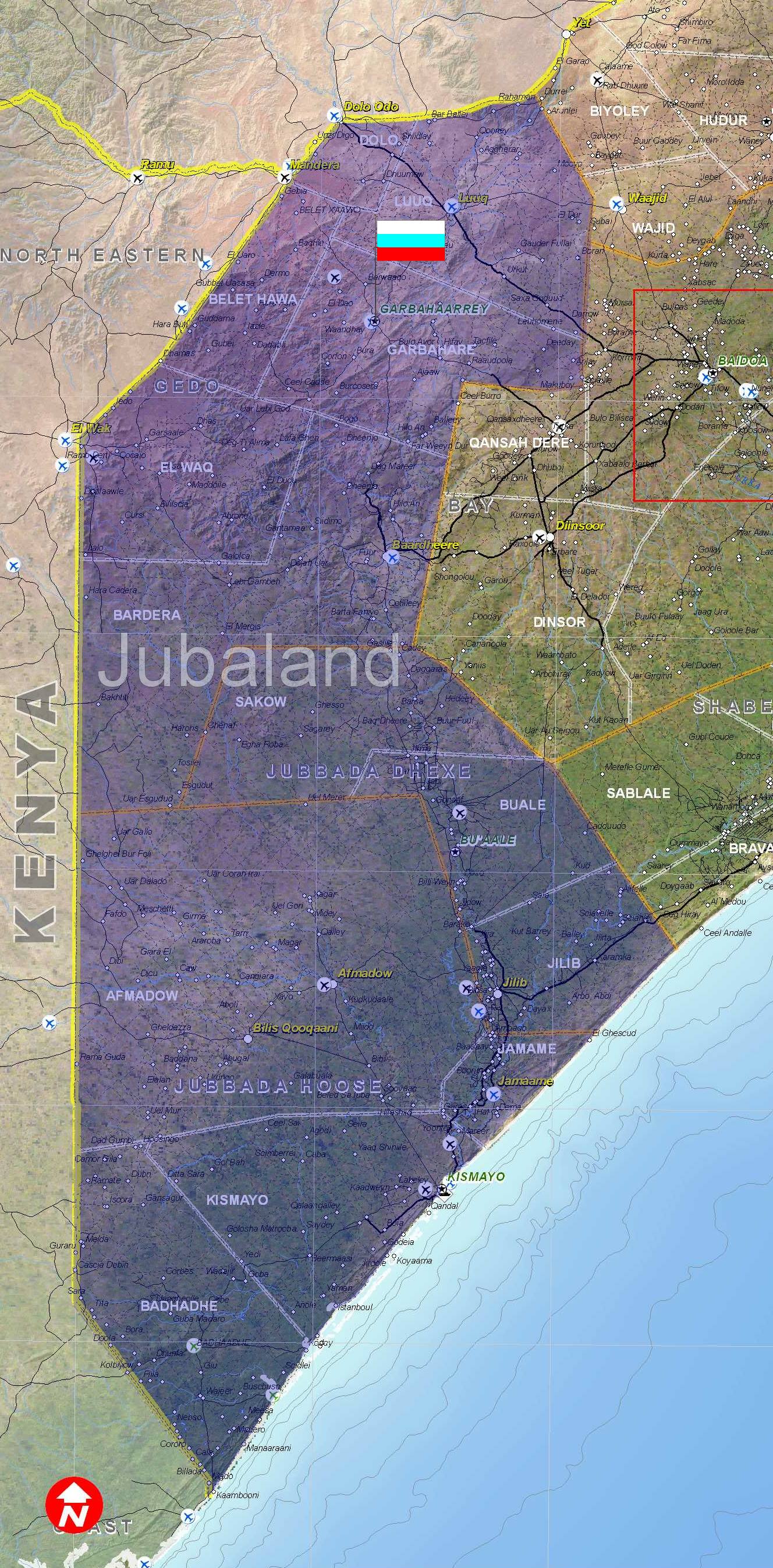

Jubaland/Azania now has a president, former Somalia Defence Minister Professor Mohamed Abdi Gandhi, who has said a main goal of his administration will be to defeat al Shabab, Somalia’s Islamic rebel movement. This, Kenya’s Daily Nation reports [http://www.nation.co.ke/News/Somalis+swear+in+the+president+of+Jubaland+/-/1056/1138186/-/m66vqdz/-/], is one of the driving goals of the new region’s creation, but Somalia’s neighbors disagree on whether this tactic is a wise one:
[begin excerpt]
"The idea to create an autonomous region near the Kenyan border is hinged on the reason that it will prevent the movement of al Shabaab extremists within the region.
As the conference ended on Sunday, it was not clear whether the Kenyan Government supported the election but recent WikiLeaks revelations showed that the country supported the creation of an autonomous region near its border with Somalia to prevent the flow of illegal arms.
The meeting had been opposed by both Ethiopia and Djibouti, who argue that creating autonomies in the war-torn country could inspire further insurgency by other regions or degrade the gains made by the TFG."
[end excerpt]
The Jubaland initiative has a long history. A Wikileaks cable [http://www.guardian.co.uk/world/us-embassy-cables-documents/249097] (see item 6) shows Kenyan support for the idea in early 2010 (via @slowfalling), and “Kenya has been pouring money [and] supplies into the Jubaland area for some time to fight [al] Shabaab.” But momentum toward the creation of an official state picked up with a seven-day conference last week that culminated in the formalization of Jubaland/Azania [http://www.standardmedia.co.ke/news/InsidePage.php?id=2000032552&cid=159&story=New%20semi-autonomous%20Somali%20state%20born].
Now it remains to see how Jubaland will negotiate its relationships with the TFG, with Kenya, and with the rest of Africa.
Commenter James Gundun [http://sahelblog.wordpress.com/2011/04/03/africa-news-roundup-nigerian-elections-postponement-princeton-lyman-senegal-protests-and-more/#comment-2273], responding to an earlier piece, leaves us with some questions and issues to think about:
[begin excerpt]
Jubaland has been in the works for years – forming a presidential cabinet electing a parliament is expected – although it’s difficult to say what comes next. While TFG officials attended the week-long conference before appointing Mohamed Abdi Gandhi, how much overlap are they willing to cede to Kenya? This arrangement can squeeze al-Shabab through local governance and attempt to remedy the refugee crisis, but friction may easily develop between Nairobi and the TFG. Ethiopia also opposes the formal recognition of Jubaland, citing fears of increased insurgency, as it monitors the newly-created Shabelle Valley administration and aspiring Somali Central State. Positive interplay between the TFG, Kenya, and Ethiopia is vital to stabilizing Somalia.
[end excerpt]
What do you think? Will this move hurt or help al Shabab, or make no substantive difference?
2011-04-06 "Kenya creates new state to act as military, political buffer; Azania is an attempt by the Nairobi government to bring order and security to northeastern border with Somalia, which is overrun by militias" by Jonathan Manthorpe from "Vancouver Sun" newspaper
[http://www.vancouversun.com/Kenya+creates+state+military+political+buffer/4567013/story.html]
With little fanfare and even less international attention, a new state of 1.3 million people called Azania was ushered into existence on Sunday.
And Azania has an interim president, Prof. Mohamed Gandhi Mohamed, who was sworn in at the end of seven days of deliberations held in the Kenyan capital Nairobi.
The venue for the discussions and the proclamation was no accident.
Azania is very much a creation of the Nairobi government and an attempt to bring order and security to Kenya's troublesome northeastern border with Somalia, where there has been no functioning administration since 1991.
Azania is to be made up of three Somali regions bordering Kenya: Lower and Middle Juba and Gedo. The capital of what some are calling Jubaland is expected to be the port city of Kismayo.
The Nairobi government of President Mwai Kibaki wants President Gandhi to create a buffer state to protect Kenya from the marauding fighters of the radical Islamic group al-Shabaab.
After his swearing in on Sunday, Gandhi said his first duty is to retake Azania from the al-Shabaab militias, which now control most of southern Somalia and travel back and forth across the border with Kenya at will.
The Kibaki government has already made preparations to give Gandhi, a former Somalia defence minister, the tools to do that job.
One of the WikiLeaks documents is a message dated Feb. 17, 2010, from the United States embassy in Nairobi to Washington, which says that the previous month the Kenyan government had received a shipment of arms and ammunition from the Chinese government "in support of the Government of Kenya's Jubaland initiative."
There's no doubt that the chaos in Somalia since the last president, Siad Barre, was ousted by warlords 20 years ago has been a real headache for Kenya.
Just two weeks ago, al-Shabaab fighters attacked two border towns, Dobley and Liboi. There was intense fighting with Kenyan security forces, and some reports say 200 people were killed and hundreds more wounded.
A continuing problem for Kenya is the Dadaab refugee camp inside Kenya, about 100 kilometres from the Somali border. The camp is holding 332,000 Somali refugees, according to the United Nations -three times the number for which it was designed when it was opened in 1991.
The camp, according to various reports, has become a rear base, rest and recreation resort and recruiting centre for al-Shabaab.
Nairobi wants Dadaab closed, the refugees sent home to Somalia. The creation of Azania is a key part of that strategy.
Kenya was a strong supporter of the United Nations and African Union-backed Somali Transitional National Government (TNG), created in 2004.
But despite the assistance of several thousand African Union troops, the TNG still controls only a few blocks of the capital, Mogadishu. There are almost daily battles and skirmishes with al-Shabaab, which controls the rest of the capital and much of the rest of southern Somalia.
Kenya's promotion of the creation of Azania is tacit admission that the Nairobi government has little confidence the TNG is going to get its act together and establish a functioning administration in Somalia any time soon.
And Azania is modelled on the two regions of Somalia where there are governments that are working reasonably well.
Soon after President Barre's ouster in 1991, northern Somalia declared itself separate.
It has been operating reasonably successfully as Somaliland since then, though it is not internationally recognized as an independent country.
Puntland, the northeastern region of Somalia, in 1998 also declared itself an autonomous region, but made it clear that, unlike Somaliland, it envisages an eventual reunification with Somalia.
Puntland was one of the main centres for piracy against shipping in the Gulf of Aden. But in the last couple of years the Puntland government, has worked hard to suppress piracy and most of the pirates in the region now operate from coastal towns further south in the region under the influence of al-Shabaab.
While the attraction to Kenya of trying to create something similar in Azania is clear, not everyone believes it can happen.
The governments of Ethiopia and Djibouti in particular fear Azania will just be a spark for more of the clan warfare that has kept Somalia in chaos for 20 years.
2011-04-03 "Somalis swear in the president of Jubaland" by AGGREY MUTAMBO
[http://www.nation.co.ke/News/Somalis+swear+in+the+president+of+Jubaland+/-/1056/1138186/-/m66vqdz/-/]
A former Somali Defence minister has been sworn in as the president of the newly created semi-autonomous region of Jubaland.
Prof Mohamed Abdi Gandhi was sworn in at a meeting of Somalis in Nairobi.
The longtime anthropology professor in France will be in charge of the area near the border between Kenya and Somalia.
The region includes the three sub-regions of Lower Juba, Middle Juba and Gedo and is estimated to have a population of 1.3 million.
The appointment followed a week-long conference that brought together representatives of the civil society, Somali youth, elders and members of the Transitional Federal Government.
Prof Gandhi had been spearheading the breakaway. But an official in charge of organising the conference said participants decided to elect Prof Gandhi because “he is the face of Jubaland in the eyes of the international community”.
The official, who requested anonymity because he is not the official spokesman, said: “Panellists viewed Prof Mohamed Gandhi as a punctual and flexible person. They thought it wise to have him lead them.”
Prior to the swearing in, Prof Gandhi had indicated he would love “to liberate Jubaland from extremists”.
The idea to create an autonomous region near the Kenyan border is hinged on the reason that it will prevent the movement of al Shabaab extremists within the region.
As the conference ended on Sunday, it was not clear whether the Kenyan Government supported the election but recent WikiLeaks revelations showed that the country supported the creation of an autonomous region near its border with Somalia to prevent the flow of illegal arms.
The meeting had been opposed by both Ethiopia and Djibouti, who argue that creating autonomies in the war-torn country could inspire further insurgency by other regions or degrade the gains made by the TFG.
The official said the election of the president was only the initial stage of making Jubaland autonomous.
The region will have to create a parliament and the president will appoint the cabinet.

2010-12-08 "US embassy cables: China providing military and intelligence gathering support to Kenya"
[http://www.guardian.co.uk/world/us-embassy-cables-documents/249097]
Summary -
In January 2010, Kenya received Chinese weapons, ammunition, supplies and textiles. Telkom Kenya awarded a contract to a Chinese company to provide landline telephone monitoring equipment after pressure from an official who received kickbacks. The US is closely watching China's growing influence in Africa.
---
Wednesday, 17 February 2010, 07:01
S E C R E T NAIROBI 000181
SENSITIVE
SIPDIS
NOFORN
EO 12958 DECL: 2020/02/17
TAGS PREL, EAID, KE, XW">XW, ECON, EINV, ENRG, EFIN, PGOV, CH, PINR
SUBJECT: Chinese Engagement in Kenya
REF: 10 STATE 10152
CLASSIFIED BY: Christopher Walton, Economics Officer, State, Econ; REASON: 1.4(B), (C), (D)
1. (S/NF) Summary: China's engagement in Kenya continues to grow exponentially. China enjoys a large trade surplus with Kenya; exports increased by more than 25 percent a year from 2004 to 2008. The China National Offshore Oil Company (CNOOC) is drilling for oil in the Isiolo region. China may be a potential partner in the development of the new mega-port at Lamu. In addition, China is heavily involved in various infrastructure projects across Kenya primarily with roads. China is also providing weapons to the GOK in support of its Somalia policies and increasing their involvement with the Kenyan National Security and Intelligence Service (NSIS) by providing telecommunications and computer equipment. Recently, China signed an economic and technical cooperation agreement with the GOK providing new development grants. To date, China and the U.S. do not collaborate on development projects in Kenya. End summary.
2. (U) China enjoys a large trade surplus with Kenya, exporting more than 30 times its imports. For 2008, China exported $917 million of goods to Kenya while China imported $29 million worth of Kenyan goods. China's exports in 2008 grew by 39 percent over 2007 capping the fourth straight year of at least 25 percent export growth, including a 54 percent increase in 2007 and a 79 percent increase in 2005. China is now the third largest exporter to Kenya after the United Arab Emirates, which principally exports oil to Kenya, and India. In comparison, the U.S. exported $440 million worth of goods to Kenya in 2008 while importing $343 million worth of Kenyan goods.
3. (U) The CNOOC is drilling for oil in the Isiolo region of Kenya (see ref A). The exploratory well will cost $26 million dollars and drilling will be complete in April 2010. Numerous oil companies have drilled 31 exploratory wells in Kenya over the last 50 years without success. However, CNOOC is making a credible effort to find oil in an area geologically similar to Southern Sudan, with its substantial oil finds. As reported ref A, we had heard that CNOOC would announce results from the exploratory well by January 2010; we are now hearing an announcement may come in April.
4. (U) The GOK is highly interested in developing a major port complex in Lamu, which has much greater potential as a deep water port than Mombasa. The GOK originally held discussions with Qatar over the development of the Lamu port in return for a substantial allocation of farm land. Negotiations involving development of the Lamu port reportedly occur inside the "black box" of President Kibaki's inner circle at State House. We understand, however, that talks with Qatar are off, and that the Chinese are in play as a potential partner for the port development project and associated regional infrastructure (road and rail infrastructure to Southern Sudan and Ethiopia, and pipeline infrastructure to Southern Sudan and Uganda). China's interest in the Lamu project is reportedly linked to the presence of oil in Southern Sudan and Uganda which could be exported via Lamu as well as the greater export potential to Ethiopia, Southern Sudan and Uganda. The addition of oil from Isiolo would add additional impetus to China's interest in the port development which is estimated to cost more than $5 billion.
5. (SBU) China is currently developing a number of infrastructure projects in Kenya. Currently, China Wuyi, Syno Hydro, and China Overseas Engineering Corporation are working on the Thika Road project, a major eight lane highway from Nairobi to Thika town. Another Chinese firm, Shengli Engineering & Consulting Company was the prime contractor for the Mombasa-City Centre-Gigiri road upgrade project. In addition, the second phase of a project to upgrade the Jomo Kenyatta International Airport (JKIA) is being worked by China National Aero-Technology International Engineering Company (CATIC). The first phase of the project was completed by the Chinese company, China Wu Yi. TBEA International, another Chinese firm, is developing a 120 MW thermal plant in Longonot and 600 MW coal-fired power station in Mombasa as an independent power producer. TBEA is also undertaking projects that involve construction of 132 kV lines and sub-stations in the Rift Valley, Central, Western and Coast provinces. During a recent visit to the Olkaria geothermal development site in the Rift Valley Province, Econoff observed that Great Wall Drilling, another Chinese company, was exploring for geothermal energy. The KenGen Olkaria Geothermal Development Manager told Econoff that while he would prefer to buy quality American drills, pipes, and other geothermal-related products, American companies could not compete with China on price and price won every time in Kenya.
6. (S/NF) In January 2010, the GOK received from the GOC via CATIC weapons, ammunition, supplies, and textiles for making uniforms in support of the GOK's Jubaland initiative.
7. (S/NF) As of late August 2009, XXXXXXXXXXXX awarded XXXXXXXXXXXX a contract to provide landline telephone monitoring equipment to XXXXXXXXXXXX. XXXXXXXXXXXX awarded the contract to XXXXXXXXXXXX after being pressured to do so by XXXXXXXXXXXX and XXXXXXXXXXXX . XXXXXXXXXXXX 's preference for is based on kickbacks he received XXXXXXXXXXXX while on a visit to China. XXXXXXXXXXXX received monthly payments of over $5000 from XXXXXXXXXXXX which were used to pay medical bills.
8. (S/NF) As of September 2008, XXXXXXXXXXXX As of early March 2009, Chinese technicians were working on a project in the basement of the NSIS headquarters. The presence of the technicians was well known throughout the NSIS and was causing some concern over the level of cooperation between the NSIS and its Chinese counterparts.
9. (U) The GOK and GOC recently signed an Economic and Technical Cooperation Agreement. The agreement provides a $7.3 million grant from China to Kenya. Of the grant, $150,000 will finance a computer program for the Ministry of Finance while the remaining funds can be used by the GOK to fund development projects of their choice. The agreement also covered Chinese funding of feasibility studies for the potential development of Lamu port. In addition, China committed to funding portions of the Northern Corridor road project, which links Mombasa and Nairobi to Ethiopia and Southern Sudan, as well as parts of the new Mombasa-Kampala standard gauge railway. Currently, China's Shengli Engineering Construction is refurbishing The Moi International Sports Complex at Kasarani with $12.8 million of grant-in-aid money from China. In Early 2009, China provided a $1 million grant to the GOK for the construction of a 100 bed hospital in Nairobi. In 2008, the GOK received approximately $381 million in interest-free and preferential loans, with $145 million intended for the planned ring roads aimed at decongesting Nairobi. Since 2008, the GOK has implemented campaigns to attract investment from the $1 billion China-Africa Development Fund.
10. (U) China's companies working in Kenya tend to import a substantial number of Chinese workers. This importation of labor from China tends to limit the number of Kenyans who directly benefit with wages and knowledge transfer from the projects. The low Chinese bids on major projects also push local firms out of the process, especially in infrastructure areas where capacity building of local firms would be useful. In addition, the Kenya Wildlife Service (KWS) noticed a marked increase in poaching wherever Chinese labor camps were located and in fact set up specific interdiction efforts aimed to reduce poaching (see ref B). KWS also reports that 90% of the ivory smugglers detained at JKIA are Chinese nationals.
11. (U) The U.S. mission in Kenya has no current or pending development partnership arrangements with the GOC or any informal collaboration at the program or project level. The GOC does not participate in donor coordination in Kenya. Donors have encouraged the GOK to bring China into the donor coordination process, but no progress has been made to date. While we do not recommend it, a potential area for collaboration could include agricultural development, a USG strength and an area of Chinese interest in Africa. However, the GOC does not participate in the multilateral agricultural donors group in Kenya. The GOC could be invited to join this donors group, predicated on their willingness to sign a Memorandum of Understanding ensuring their support of Kenya's long term agriculture strategy. The World Bank recently announced a new initiative to work in cooperation with Chinese infrastructure development in Africa. This new effort seems to be aimed at working with China and African countries to maximize the benefits of Chinese development aid to the African people.
12. (SBU) Comment: Collaboration between the USG and China in Kenya should be approached cautiously as there appears to be little dovetailing of our interests to date. The GOC has been silent on the implementation of the reform agenda, which we consider essential to Kenya's future stability and prosperity; the GOC turns a blind eye to the flooding of the Kenyan market with Chinese counterfeit goods, such as batteries, which directly damage U.S. market share here; and the GOC has not demonstrated any commitment to curb ivory poaching. We expect China's engagement in Kenya to continue to grow given Kenya's strategic location. If oil or gas is found in Kenya, this engagement will likely grow even faster. Kenya's leadership may be tempted to move ever closer to China in an effort to shield itself from Western, and principally U.S., pressure to reform. Given the possibility of a backlash by the Kenyan people against China, perhaps over the issue of imported Chinese labor or mishandling of natural resources, there may be benefits to keeping our distance, at least publicly, from China. RANNEBERGER
Monday, January 31, 2011
2011-01-31 "For bayou Indians, spill threatens a way of life" by Cain Burdeau from "Associated Press" newswire
MONTEGUT, La. – Even before oil began spewing into the Gulf of Mexico last spring, Louisiana's American-Indian fishing villages were on the brink of collapse because of social change and the dramatic loss of coastal wetlands.
Now, Indians who've known nothing but fishing all their lives find their futures tied to the man handing out checks for damages, paid from a multibillion-dollar fund started after the April 20 Gulf spill.
Kenneth Feinberg, the fast-talking East Coast lawyer in charge of BP PLC's $20 billion compensation fund, met with them for the first time Friday night on the back bayous of south Louisiana at a gymnasium in Montegut, about an hour and a half from New Orleans. Dozens of fishermen showed up in shrimp boots and work clothes, speaking a mixture of French and English.
They want Feinberg to compensate them not just for lost wages, but a way of life that relied on the bounty of the marshes and now is in jeopardy.
"The people have been independent for so long, a lot of them will go trawling, they'll bring an ice chest (of seafood) to maman, grandpa, auntie, the uncles and all that," said Thomas Dardar, the principal chief of the United Houma Nation, the largest Indian tribe with about 17,000 members.
"With the oil, how long will it last? Oil isn't like a hurricane," he said. "You can't just pick up after it's over. The Indians in Alaska after Exxon-Valdez tell us they've been dealing with the oil for 20 years."
Many tribes moved into the swamps to escape enslavement or forced banishment after Congress passed the 1830 Indian Removal Act.
Until the 1950s, most Indians lived in isolation, rarely interacting with whites. Old-timers recall barefoot children scampering into the woods to hide when the first cars rattled into their villages in the 1950s. Indian children were barred from schools until the 1960s and were called "sabines," a derogatory term.
There are about 20,000 American Indians in coastal Louisiana who trace their roots to Houma, Chitimacha, Choctaw and Biloxi tribes.
Tribal leaders say they're worried many members won't be compensated fairly, so they've brought on a New York City law firm to help the tribes navigate the difficult claims process.
All the paperwork and documentation isn't easy in these marshes, a place where some people can't read or write, where lawyers and taxes often are blurry concepts.
Take Price Billiot, 63, who runs a seafood dock in Pointe-Aux-Chenes, a dilapidated and water-bound town that stretches along a bayou in the tall marshes near Montegut.
He quit fourth grade to start working on a boat with his father, cleaning oysters. His wife has to help him with all the BP claims paperwork, he said — he can spell and read a bit, but not enough to handle it on his own.
"The white people didn't want me to go to school," he said. "We couldn't go to the school, we couldn't go to the bar up the bayou."
With hurricane damage still to fix and business slow from the spill, he was gloomy about the future.
"Every year it gets worse. You can't make a living," he said as a rooster and peacock crowed in the grasses across the road. A fishing boat abandoned long ago sat rotting into the mud across the bayou. "When I was young you could make a good living."
For now, he's surviving, in part thanks to $65,000 in emergency payments BP gave him in June for his business losses. But Billiot said his company was worth $1 million a year and that he needed much more from BP to keep it going. Feinberg is now calculating long-term damage claims like one Billiot might file for potential future losses.
Feinberg told those at his first meeting with Indian tribes Friday that he wanted to pay them claims for the value seafood and hunting plays in their everyday lives — so-called "subsistence claims."
"It's a claim that my lifestyle has been adversely impacted by my inability to any longer live off the resources that I hunt or catch," he said. "... What I could go hunt or fish I now have to go buy.
"Those claims should be paid."
Even if they're paid the spill has created even more uncertainty for people on the bayous, where life is a struggle. Families have been driven inland from their ancestral villages, battered by hurricanes and low seafood prices. And their coastal land is disappearing: About 2,300 square miles of marsh have converted to open water since the 1930s largely because of the Army Corps of Engineers' construction of levees in the Mississippi River delta and thousands of miles of canals dug by oil companies.
Now it's nearly impossible to turn a profit for any seafood caught by people like Anthony Dardar, a 28-year-old fisherman in Pointe-Aux-Chenes who's trying to get back to fishing. He'd just brought in a few sacks of oysters.
"We can't hardly move the oysters, we could hardly move the shrimp, it's hard to move the crabs," he said. "Now, they're finding all kind of freakin' dispersant in the water. Who knows about the future."
MONTEGUT, La. – Even before oil began spewing into the Gulf of Mexico last spring, Louisiana's American-Indian fishing villages were on the brink of collapse because of social change and the dramatic loss of coastal wetlands.
Now, Indians who've known nothing but fishing all their lives find their futures tied to the man handing out checks for damages, paid from a multibillion-dollar fund started after the April 20 Gulf spill.
Kenneth Feinberg, the fast-talking East Coast lawyer in charge of BP PLC's $20 billion compensation fund, met with them for the first time Friday night on the back bayous of south Louisiana at a gymnasium in Montegut, about an hour and a half from New Orleans. Dozens of fishermen showed up in shrimp boots and work clothes, speaking a mixture of French and English.
They want Feinberg to compensate them not just for lost wages, but a way of life that relied on the bounty of the marshes and now is in jeopardy.
"The people have been independent for so long, a lot of them will go trawling, they'll bring an ice chest (of seafood) to maman, grandpa, auntie, the uncles and all that," said Thomas Dardar, the principal chief of the United Houma Nation, the largest Indian tribe with about 17,000 members.
"With the oil, how long will it last? Oil isn't like a hurricane," he said. "You can't just pick up after it's over. The Indians in Alaska after Exxon-Valdez tell us they've been dealing with the oil for 20 years."
Many tribes moved into the swamps to escape enslavement or forced banishment after Congress passed the 1830 Indian Removal Act.
Until the 1950s, most Indians lived in isolation, rarely interacting with whites. Old-timers recall barefoot children scampering into the woods to hide when the first cars rattled into their villages in the 1950s. Indian children were barred from schools until the 1960s and were called "sabines," a derogatory term.
There are about 20,000 American Indians in coastal Louisiana who trace their roots to Houma, Chitimacha, Choctaw and Biloxi tribes.
Tribal leaders say they're worried many members won't be compensated fairly, so they've brought on a New York City law firm to help the tribes navigate the difficult claims process.
All the paperwork and documentation isn't easy in these marshes, a place where some people can't read or write, where lawyers and taxes often are blurry concepts.
Take Price Billiot, 63, who runs a seafood dock in Pointe-Aux-Chenes, a dilapidated and water-bound town that stretches along a bayou in the tall marshes near Montegut.
He quit fourth grade to start working on a boat with his father, cleaning oysters. His wife has to help him with all the BP claims paperwork, he said — he can spell and read a bit, but not enough to handle it on his own.
"The white people didn't want me to go to school," he said. "We couldn't go to the school, we couldn't go to the bar up the bayou."
With hurricane damage still to fix and business slow from the spill, he was gloomy about the future.
"Every year it gets worse. You can't make a living," he said as a rooster and peacock crowed in the grasses across the road. A fishing boat abandoned long ago sat rotting into the mud across the bayou. "When I was young you could make a good living."
For now, he's surviving, in part thanks to $65,000 in emergency payments BP gave him in June for his business losses. But Billiot said his company was worth $1 million a year and that he needed much more from BP to keep it going. Feinberg is now calculating long-term damage claims like one Billiot might file for potential future losses.
Feinberg told those at his first meeting with Indian tribes Friday that he wanted to pay them claims for the value seafood and hunting plays in their everyday lives — so-called "subsistence claims."
"It's a claim that my lifestyle has been adversely impacted by my inability to any longer live off the resources that I hunt or catch," he said. "... What I could go hunt or fish I now have to go buy.
"Those claims should be paid."
Even if they're paid the spill has created even more uncertainty for people on the bayous, where life is a struggle. Families have been driven inland from their ancestral villages, battered by hurricanes and low seafood prices. And their coastal land is disappearing: About 2,300 square miles of marsh have converted to open water since the 1930s largely because of the Army Corps of Engineers' construction of levees in the Mississippi River delta and thousands of miles of canals dug by oil companies.
Now it's nearly impossible to turn a profit for any seafood caught by people like Anthony Dardar, a 28-year-old fisherman in Pointe-Aux-Chenes who's trying to get back to fishing. He'd just brought in a few sacks of oysters.
"We can't hardly move the oysters, we could hardly move the shrimp, it's hard to move the crabs," he said. "Now, they're finding all kind of freakin' dispersant in the water. Who knows about the future."
Monday, January 10, 2011
Modoc Nation publicizes fact of USA non-recognition of UN Declaration on the Rights of Indigenous Peoples
2011-01-01 "Modoc Nation rips UN declaration" posted by Rob Schmidt at "Newspaper Rock Where Native America meets pop culture" online journal
[http://newspaperrock.bluecorncomics.com/2011/01/modoc-nation-rips-un-declaration.html]
Recently conservatives have had fun concocting a new racist smear campaign against Obama [http://newspaperrock.bluecorncomics.com/2010/12/obamas-un-coup-is-chilling.html] and liberals have had fun mocking them.
Now let's return to the actual UN Declaration on the Rights of Indigenous Peoples and see how harmless it really is.
Here's part of a press release from the Modoc Nation [http://modoc-nation.blogspot.com/2010/12/press-release-from-modoc-nation-re.html?spref=fb]:
[begin excerpt of press release]
"State Department White Paper Contradicts Obama’s Statements at Tribal Nations Conference; Shows U.S. Endorsement of UNDRIP Really Means Politics and Business as Usual; U.S. State Department position: UNDRIP unnecessary to protect rights of Native Americans"
The white paper issued by the State Department fleshing out the details of the U.S. endorsement of UNDRIP is really quite disappointing. Largely a laundry list of everything the federal government has done for the indigenous people of this country over the last two years, its primary message can be boiled down to: “We’re already doing all these wonderful things to help out the native peoples that live in our country, so U.S. endorsement of UNDRIP is unnecessary. But since we want to continue in our role as the leader of the free world, and the United States always stands up for what is right, we’ll go ahead and endorse it anyway.” This conclusion is all but confirmed when one reads the fine print of the article and finds that the United States government’s application and implementation of UNDRIP will be limited largely to already existing federally recognized tribes and be carried out within the framework of existing US and state law. In other words, even though the United States is “endorsing” UNDRIP, it sees no need to alter any of its laws or policies pertaining to the indigenous peoples within its national boundaries and jurisdiction. In fact, the State Department says the United States should serve as a “model” to the rest of the world in this regard.
[ ... ]
US endorsement ignores UNDRIP’s obligation of nation-states to honor their treaties with indigenous peoples: "Article 37 -
1. Indigenous peoples have the right to the recognition, observance and enforcement of treaties, agreements and other constructive arrangements concluded with States or their successors and to have States honour and respect such treaties, agreements and other constructive arrangements.
2. Nothing in this Declaration may be interpreted as diminishing or eliminating the rights of indigenous peoples contained in treaties, agreements and other constructive arrangements."
Incredibly, this critical issue is not even discussed in the State Department’s white paper. In fact the word “treaties” appears only twice, both times in the same paragraph, in which the State Department lauds the National Oceanographic and Atmospheric Administration (NOAA) for consulting with “Northwest treaty tribes” regarding the designation of critical habitat and with four other unnamed tribes regarding their “ocean treaty fishing rights for groundfish in conjunction with the Pacific Fishery Management Council process.” While we all are grateful for the rare occasions in which the U.S. government “consults” with us, it is laughable that the Obama Administration has announced its “support” of UNDRIP without even addressing the issue of honoring treaties, one of the bedrock elements of UNDRIP. Apparently, this Administration, like its predecessors, continues to view treaties with native nations, tribes and bands as documents that have no real force of law and, therefore, are subject to being breached or abrogated whenever it is convenient for the U.S. government to do so. In fact, the Supreme Court enshrined this practice and made it “legal” when it invented by interpretation the “plenary powers of Congress” doctrine (see Lone Wolf v. Hitchcock, 187 U.S. 553, 23. S. Ct. 216, 47 L. Ed. 299 (1903)). So, we now see that this Administration plans to make no change with respect to its recognition, observance or enforcement of treaties it has struck with indigenous peoples. Rather than come right out and say that, however, the State Department has just ignored the issue entirely.
[end excerpt of press release]
Comment: As Wikipedia notes about the Modoc [http://en.wikipedia.org/wiki/Modoc]:
"The Modoc are a Native American people who originally lived in the area which is now northeastern California and central Southern Oregon. They are currently divided between Oregon and Oklahoma. The latter are a federally recognized tribe, the Modoc Tribe of Oklahoma. The Oregon Modoc are enrolled in the federally recognized Klamath Tribes."
So the Modoc Nation is an unrecognized tribe, which is why it spends time bemoaning the administration's focus on recognized tribes. But still, this is a great critique. I think the second point is the telling one.
How do you "endorse" or "support" indigenous rights without explicitly stating you'll honor the treaties you signed?
That's why I have to shake my head at those who think this "aspirational" document will move Natives closer to a just world.
One, it has zero legal force; it's not binding on the US, future administrations, or Obama himself.
Two, the white paper offers no significant discussions of tribal sovereignty [http://www.bluecorncomics.com/sovreign.htm], treaty rights, or government-to-government relations. So tribes are "aspiring" to nothing except the status quo.
For more on the subject, see
- "UN Declaration = Status Quo" [http://newspaperrock.bluecorncomics.com/2010/12/un-declaration-status-quo.html]
- "What Supporting the UN Declaration Means". [http://newspaperrock.bluecorncomics.com/2010/12/what-supporting-un-declaration-means.html]
---
[comment following original article posting]
Two Eagles, Kokiwas Band, Modoc Nation said...
Great post, but I would like to clear up the erroneous statement that the Modoc Nation is not a federally recognized tribe. The Modoc Nation is a name change for the Modoc Tribe, which, until June 19, 2010 was one of three tribes in a confederation known as the Klamath Tribes (plural).
On that date, the Modoc People ratified a modern constitution, elected their own government, and issued a declaration dissolving all allegiance and political ties to the Klamath tribal government. In other words, they exercised their sovereign right to change their government and political affiliation. (see www.modoc-nation.org)
Federal recognition of the Modoc Tribe (Nation) began with the Lakes Treaty of 1864, continued until the Termination Act of 1954, and was restored by an act of Congress in 1986.
The Federal Register listing of recognized tribes lists the "Klamath Tribes" (plural) and includes the Modoc Tribe and Yahooskin Band of Snake Indians. So the Modoc Nation (formerly Tribe) is, indeed, a federally recognized tribe. Any arguments to the contrary are based on assumptions or complex legal theories that would have to be proven in court.
---
[The author replies]
I see the Klamath Tribes and the Modoc Tribe of Oklahoma in the Federal Register (below).
I don't see the Yahooskin Band of Snake Indians or any other Modoc Nation or Tribe. [http://www.bia.gov/idc/groups/xofa/documents/document/idc012038.pdf]
I'm pretty sure the federal government recognizes the Klamath Tribes as a single entity. That doesn't mean it recognizes each of the component tribes also. I believe they're recognized only as part of the whole. Exercising your rights and declaring your independence doesn't necessarily mean the feds recognize these things.
Where exactly is the Modoc Nation listed as an entity separate from the Klamath Tribes?
Which government programs for federally recognized tribes does the Modoc Nation participate in? Etc.
Until I see hard evidence, not just legal rhetoric, I'll continue to stand by my assertion.
As far as I know, the Modoc Nation of Washington (?) isn't a federally recognized tribe.
[http://newspaperrock.bluecorncomics.com/2011/01/modoc-nation-rips-un-declaration.html]
Recently conservatives have had fun concocting a new racist smear campaign against Obama [http://newspaperrock.bluecorncomics.com/2010/12/obamas-un-coup-is-chilling.html] and liberals have had fun mocking them.
Now let's return to the actual UN Declaration on the Rights of Indigenous Peoples and see how harmless it really is.
Here's part of a press release from the Modoc Nation [http://modoc-nation.blogspot.com/2010/12/press-release-from-modoc-nation-re.html?spref=fb]:
[begin excerpt of press release]
"State Department White Paper Contradicts Obama’s Statements at Tribal Nations Conference; Shows U.S. Endorsement of UNDRIP Really Means Politics and Business as Usual; U.S. State Department position: UNDRIP unnecessary to protect rights of Native Americans"
The white paper issued by the State Department fleshing out the details of the U.S. endorsement of UNDRIP is really quite disappointing. Largely a laundry list of everything the federal government has done for the indigenous people of this country over the last two years, its primary message can be boiled down to: “We’re already doing all these wonderful things to help out the native peoples that live in our country, so U.S. endorsement of UNDRIP is unnecessary. But since we want to continue in our role as the leader of the free world, and the United States always stands up for what is right, we’ll go ahead and endorse it anyway.” This conclusion is all but confirmed when one reads the fine print of the article and finds that the United States government’s application and implementation of UNDRIP will be limited largely to already existing federally recognized tribes and be carried out within the framework of existing US and state law. In other words, even though the United States is “endorsing” UNDRIP, it sees no need to alter any of its laws or policies pertaining to the indigenous peoples within its national boundaries and jurisdiction. In fact, the State Department says the United States should serve as a “model” to the rest of the world in this regard.
[ ... ]
US endorsement ignores UNDRIP’s obligation of nation-states to honor their treaties with indigenous peoples: "Article 37 -
1. Indigenous peoples have the right to the recognition, observance and enforcement of treaties, agreements and other constructive arrangements concluded with States or their successors and to have States honour and respect such treaties, agreements and other constructive arrangements.
2. Nothing in this Declaration may be interpreted as diminishing or eliminating the rights of indigenous peoples contained in treaties, agreements and other constructive arrangements."
Incredibly, this critical issue is not even discussed in the State Department’s white paper. In fact the word “treaties” appears only twice, both times in the same paragraph, in which the State Department lauds the National Oceanographic and Atmospheric Administration (NOAA) for consulting with “Northwest treaty tribes” regarding the designation of critical habitat and with four other unnamed tribes regarding their “ocean treaty fishing rights for groundfish in conjunction with the Pacific Fishery Management Council process.” While we all are grateful for the rare occasions in which the U.S. government “consults” with us, it is laughable that the Obama Administration has announced its “support” of UNDRIP without even addressing the issue of honoring treaties, one of the bedrock elements of UNDRIP. Apparently, this Administration, like its predecessors, continues to view treaties with native nations, tribes and bands as documents that have no real force of law and, therefore, are subject to being breached or abrogated whenever it is convenient for the U.S. government to do so. In fact, the Supreme Court enshrined this practice and made it “legal” when it invented by interpretation the “plenary powers of Congress” doctrine (see Lone Wolf v. Hitchcock, 187 U.S. 553, 23. S. Ct. 216, 47 L. Ed. 299 (1903)). So, we now see that this Administration plans to make no change with respect to its recognition, observance or enforcement of treaties it has struck with indigenous peoples. Rather than come right out and say that, however, the State Department has just ignored the issue entirely.
[end excerpt of press release]
Comment: As Wikipedia notes about the Modoc [http://en.wikipedia.org/wiki/Modoc]:
"The Modoc are a Native American people who originally lived in the area which is now northeastern California and central Southern Oregon. They are currently divided between Oregon and Oklahoma. The latter are a federally recognized tribe, the Modoc Tribe of Oklahoma. The Oregon Modoc are enrolled in the federally recognized Klamath Tribes."
So the Modoc Nation is an unrecognized tribe, which is why it spends time bemoaning the administration's focus on recognized tribes. But still, this is a great critique. I think the second point is the telling one.
How do you "endorse" or "support" indigenous rights without explicitly stating you'll honor the treaties you signed?
That's why I have to shake my head at those who think this "aspirational" document will move Natives closer to a just world.
One, it has zero legal force; it's not binding on the US, future administrations, or Obama himself.
Two, the white paper offers no significant discussions of tribal sovereignty [http://www.bluecorncomics.com/sovreign.htm], treaty rights, or government-to-government relations. So tribes are "aspiring" to nothing except the status quo.
For more on the subject, see
- "UN Declaration = Status Quo" [http://newspaperrock.bluecorncomics.com/2010/12/un-declaration-status-quo.html]
- "What Supporting the UN Declaration Means". [http://newspaperrock.bluecorncomics.com/2010/12/what-supporting-un-declaration-means.html]
---
[comment following original article posting]
Two Eagles, Kokiwas Band, Modoc Nation said...
Great post, but I would like to clear up the erroneous statement that the Modoc Nation is not a federally recognized tribe. The Modoc Nation is a name change for the Modoc Tribe, which, until June 19, 2010 was one of three tribes in a confederation known as the Klamath Tribes (plural).
On that date, the Modoc People ratified a modern constitution, elected their own government, and issued a declaration dissolving all allegiance and political ties to the Klamath tribal government. In other words, they exercised their sovereign right to change their government and political affiliation. (see www.modoc-nation.org)
Federal recognition of the Modoc Tribe (Nation) began with the Lakes Treaty of 1864, continued until the Termination Act of 1954, and was restored by an act of Congress in 1986.
The Federal Register listing of recognized tribes lists the "Klamath Tribes" (plural) and includes the Modoc Tribe and Yahooskin Band of Snake Indians. So the Modoc Nation (formerly Tribe) is, indeed, a federally recognized tribe. Any arguments to the contrary are based on assumptions or complex legal theories that would have to be proven in court.
---
[The author replies]
I see the Klamath Tribes and the Modoc Tribe of Oklahoma in the Federal Register (below).
I don't see the Yahooskin Band of Snake Indians or any other Modoc Nation or Tribe. [http://www.bia.gov/idc/groups/xofa/documents/document/idc012038.pdf]
I'm pretty sure the federal government recognizes the Klamath Tribes as a single entity. That doesn't mean it recognizes each of the component tribes also. I believe they're recognized only as part of the whole. Exercising your rights and declaring your independence doesn't necessarily mean the feds recognize these things.
Where exactly is the Modoc Nation listed as an entity separate from the Klamath Tribes?
Which government programs for federally recognized tribes does the Modoc Nation participate in? Etc.
Until I see hard evidence, not just legal rhetoric, I'll continue to stand by my assertion.
As far as I know, the Modoc Nation of Washington (?) isn't a federally recognized tribe.
Subscribe to:
Posts (Atom)